
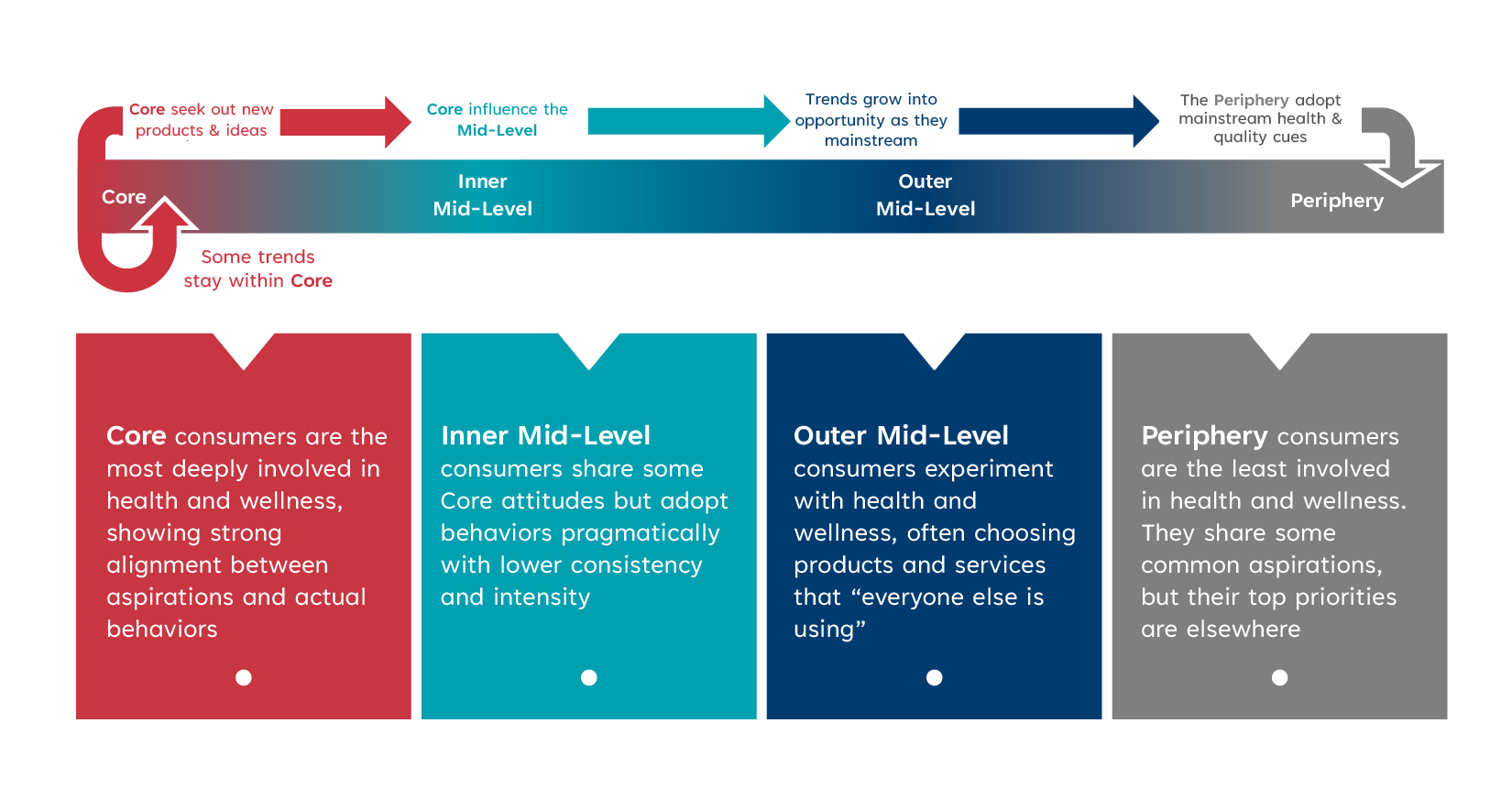
Chatter about AI is constant. (Almost) everything is being automated. New tools and technologies launch daily with the promise of solving all of your research dilemmas. In other words, “shiny objects” are everywhere you look, and trying to determine what’s worth your time can be dizzying.
Amidst all this hype, we remain convinced that time is the great equalizer. There’s a reason why certain solutions have staying power—solutions that have withstood decades of pressure testing, validation and refinement with real consumers for real clients facing real challenges.
And that’s exactly what Hartman Group’s World of Health and Wellness Model was built to do way back in 1999—back when the cultural focus was more so on fixing the Millennium Bug and dressing like Keanu Reeves in The Matrix than it was on the fledgling health and wellness movement.
But we saw that movement brewing beneath the surface. At the same time, we were beginning to see limitations in traditional consumer segmentation frameworks when it came to this new wellness consumer.
As one of the masterminds behind the World Model—Jarrett Paschel, Ph.D.—puts it:
It dawned on us that market researchers and business people had traditionally been choosing to view the consumer as an individual, robot-like processor and then preoccupy themselves with trying to understand all of the instructions and logic that make these “processors” operate in the fashion they do. Yet surely we all recognize that consumers are, first and foremost “animals.” As such, they are inseparable from “nature” (in this case, the larger environment of commerce and consumption). Why not, then, move our eye (temporarily) away from the autonomous, individual consumer and focus, instead, on elements of the larger environment that guide and direct consumer thinking, behavior and consciousness? ‘Maybe it’s time,’ we thought to ourselves, ‘that we pay as much attention to the world as we do the consumer.’”
And after much tinkering, the World of Health and Wellness Model was born.
Unlike platforms that aggregate large datasets for DIY market insights (which are an entirely recent invention), the World of Health and Wellness model provides a framework for strategic consulting and decision intelligence, grounded in decades of direct consumer engagement and cultural analysis with leading food and beverage companies.
The result is not just insight into what consumers are saying about wellness—but a proven strategic model that helps companies translate evolving health values into meaningful growth opportunities.
The World Model helps us advise clients on:
Which consumers to target
How to innovate
Where to be in the marketplace (retail and foodservice)
How and where to market to their targets
Simply put: when it comes to making decisions you can stand behind, Hartman’s World Model is what you need.
If you’re a longstanding client of ours, you’ve likely witnessed the powerful strategic breakthroughs the World Model can surface firsthand. But if you haven’t, we invite you to travel back to 1999 to see how the sauce got made—and why the recipe still holds 27 years later.
[The following is an excerpt from Jarrett Paschel, Ph.D.* and Harvey Hartman’s original publication describing the World Model (then called “The World Perspective”) in Hartman Group’s N|Sight Magazine. The piece has been edited for brevity.
* In light of Jarrett’s recent passing, we extend our heartfelt condolences to his family and friends. We remain deeply grateful for the contributions he made during his time at Hartman Group and for the impact of his work on advancing consumer insights. His passion, curiosity and playful irreverence will be greatly missed.
-----------------------
Introducing the World Perspective
By Harvey Hartman and Jarrett Paschel, Ph.D. | Published Summer 1999
At its most basic, the world perspective requires the researcher or analyst to take seriously all of the individuals, organizations, institutions and cultural practices that contribute to or shape the task at hand.
Perhaps it is best to think of a world as resembling a globe (e.g. earth). Within any given world of activity, we can envision a center (we’ll label that the “core”) as well as an outer edge (we’ll call that the “periphery”).The individuals and organizations in the core are those most active in a given world of activity, while those at the periphery are those maintaining only minimal, infrequent and less intense involvement with the given world. Typically the people and organizations comprising the center of a given world of activity are much smaller in number than those connected to the periphery.
Dimensions within the worlds
As anyone who has ever encountered a wine geek or outdoor enthusiast knows all too well, the folks at the center of a given world see things very differently than those at the edges. What to the ordinary person looks like a boot may actually be the state of the art in outdoor climbing gear, replete with titanium shanks and weighing in at a measly 12 oz. Likewise, whereas most of us will see a glass of wine and think “red” or “cabernet,” the nervous wine geek will express concern over vintage and vinification techniques, wondering if his 1994 Caymus Special Selection Cabernet will make a good match for a grilled beef tenderloin. These observations of social life arise illustrate the dimensions that serve to organize and order activity within a world differ depending on the location within the world.
Certain dimensions can organize and affect some areas of a world more strongly than others. For example, we find several important dimensions in the world of wine—one of which is price. Our research demonstrates that while price is very important for individuals located in the periphery (those loosely connected with the wine world), it is of minimal importance for those at the core as those individuals are concerned about more significant things. Rather, when looking at the world from an aggregate (and, hence, not individual) perspective, price ceases to be of serious concern.
Identifying, locating and understanding these dimensions (i.e. What are they? Where and how do they operate?) should be the first order of business for anybody wishing to truly comprehend a given world of activity.
World of Wellness
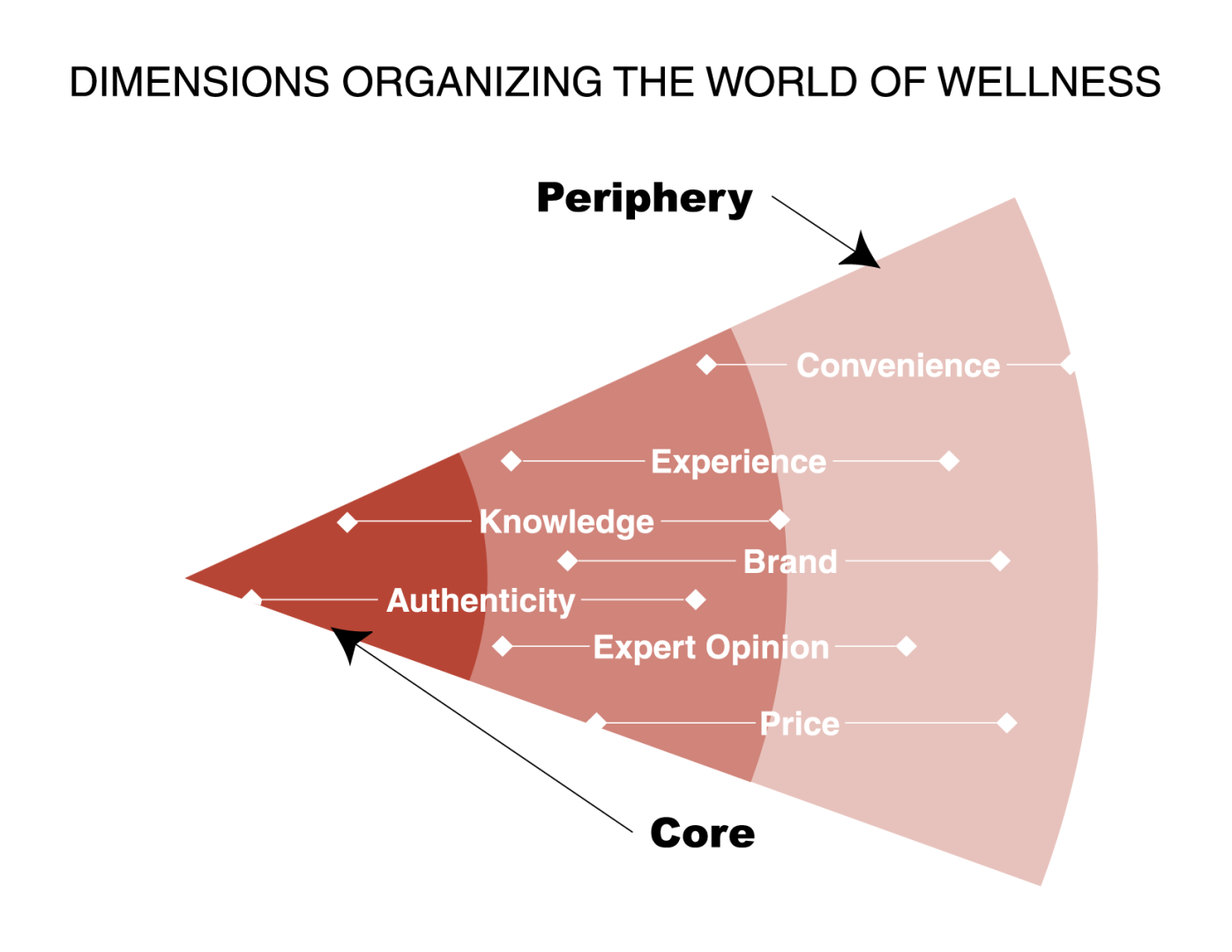
In the “core” or center of the wellness world, knowledge and authenticity are two key dimensions of interest. Be they consumer, practitioner or arbiter of expert opinion, most of these folks are actively engaged in the pursuit of specialized knowledge about wellness products and services. Note that this is intensely focused knowledge—not something merely gleaned from a package label or an article in TIME magazine. Authenticity also plays a crucial role here, as consumers appear very concerned with isolating the most authentic of wellness products and services. Price becomes less of a factor as we hover around the center, or core, of the world.
On the other end of the spectrum, the periphery of the wellness world, consumers appear most oriented toward convenience and price and much less oriented toward authenticity and knowledge. Finally, as we hover about the “middle” of the world, price starts to decline in significance as experience, brand and expert opinion begin to emerge as key orienting principles.
So, what should an earnest manufacturer, brand manager or retailer do with such information? For starters, get a clear handle on the segment of the world you intend to target. This includes an understanding of where in the world their current customer base lies, as well as the segment of the world you wish to target.
-------
To learn more about how the World Model can support your unique business objectives, please reach out to Shelley Balanko for a demo call: shelley@hartman-group.com.