
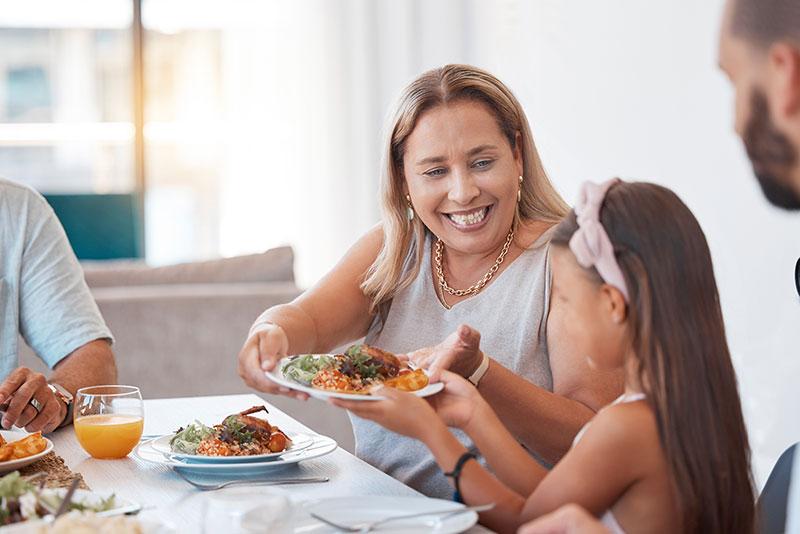
For the past two years, much of the conversation around GLP-1 medications has focused on the individual consumer. As appetite-suppressing drugs gain widespread adoption, the prevailing narrative has centered on how reduced appetite, altered cravings and shifting consumption patterns will reshape demand across the food economy.
But while understanding the GLP-1 user is critical, it is insufficient. The more consequential shift may be happening at the household level. For example...
What happens when one person stops eating the way they used to—within a system built around shared meals, routines and competing needs?
The potential influence of GLP-1 medications exists along a spectrum, extending from individual appetite and behavior changes to broader shifts in household-level patterns such as cooking routines, grocery baskets and shared eating occasions. This is where GLP-1 drugs’ wider impact on food culture ultimately takes shape.
Individual behavior is changing household spending
Early research confirms that GLP-1 users are making measurable changes to their food purchasing. A 2024 study by Cornell University and Numerator found that households with at least one GLP-1 user reduced grocery spending by 5.3% within six months of adoption, with the largest declines occurring in calorie-dense processed categories such as savory snacks (-10.1%) and fast food (-8%).1 These changes persisted through the first year of medication use,1 suggesting that many GLP-1 users are indeed aligning their purchasing behavior with their health goals.
Actual consumption patterns remain more nuanced
Despite these shifts, household-level consumption tells a more complicated story. The same Cornell study found that once GLP-1 usage stopped, households largely returned to their previous grocery spending patterns.1 A recent study out of Denmark that analyzed over 13,000 grocery receipts showed only modest nutritional shifts in the grocery basket—calorie density declined by about 2 kcal per 100g of purchased food, with small reductions in sugar and slight increases in protein.2
At the same time, certain indulgent categories remain resilient—and in some cases are growing. Circana data shows GLP-1 users increased spending on premium chocolate by nearly 17% in 2025—far outpacing the 6.5% growth among non-users.3
Why is this happening?
Taken together, these findings suggest that GLP-1 medications are not simply reducing consumption but are reshaping how households balance nutrition, indulgence and routine. We see several dynamics at play:
1. Households do not behave like individual consumers
Even when one person’s appetite changes dramatically, the broader realities of feeding a household remain. Meals still need to be planned and prepared, lunches still need to be packed and grocery carts still reflect multiple competing preferences and routines. For families with children, snacks and convenience items often persist as staples regardless of one member’s reduced intake.
And while eating is highly individualistic, food is also a powerful social connector. Shared rituals—like dessert, takeout nights or celebratory meals—may be reinterpreted or reduced when a household member is taking GLP-1 medication, which can subtly change how households connect around food.
2. GLP-1s fundamentally differ from traditional dieting
Traditional dieting relies on restriction—removing “off-limits” foods to manage temptation. GLP-1s change that equation. With appetite biologically suppressed and “food noise” reduced, the need to eliminate indulgent foods diminishes. Indulgent foods may remain in the pantry—not as frequent consumption items but as neutralized temptations.
3. Indulgence is being premiumized—not eliminated
As appetite decreases, consumption becomes more selective. Rather than eliminating treats, some consumers are trading up—choosing smaller, higher-quality indulgences where every bite is more meaningful. In this sense, GLP-1 medications may be reordering the architecture of the grocery basket, where fewer occasions carry greater expectation.
Questions the food industry still needs to answer
Make no mistake: understanding GLP-1 users will remain critical. But understanding GLP-1 households could ultimately prove more important long-term.
Key questions remain:
- Which products and categories persist in the household basket despite GLP-1 use?
- How are meal routines evolving when one household member eats differently or significantly less?
- What new friction points or unmet needs are emerging as consumers navigate food shopping, cooking and meal planning in GLP-1 households?
Hartman Group’s upcoming special report, GLP-1s: Seizing Opportunity in a New CPG Landscape will explore these dynamics in depth, helping CPG leaders understand the impact of GLP-1 use on consumers, culture and the food industry at large. It will capture usage and attitudes for key retail channels and product categories while also identifying emerging perceptions and expectations, new patterns of behavior and exciting opportunities—among GLP-1 users and the general population alike.
Sources:
1. The No-Hunger Games: How GLP-1 Medication Adoption is Changing Consumer Food Demand, Cornell SC Johnson School of Business, December 2024
2. Consumer Food Purchases After Glucagon-Like Peptide-1 Receptor Agonist Initiation, Diabetes and Endocrinology, January 2026
3. Rising GLP-1 use reshapes food spending, EMarketer, March 2026